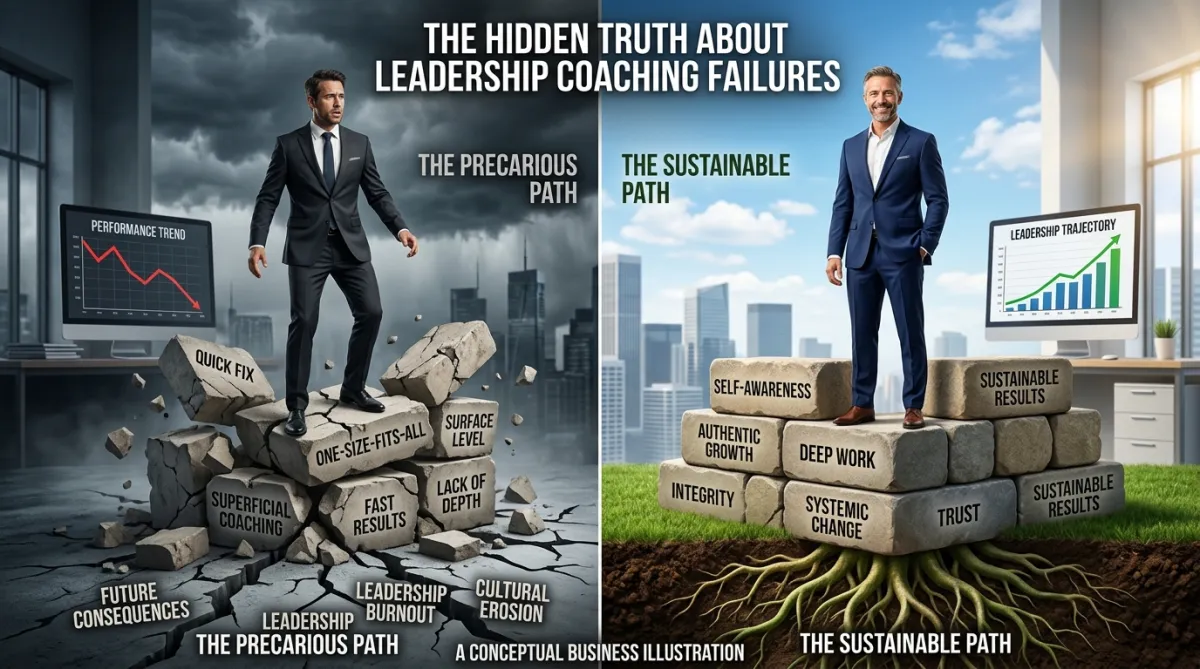
The Hidden Truth About Leadership Coaching
Why Most Leaders Get It Wrong (And Pay for It Later)
Most leaders can't tell the difference between coaching to help team members grow and directing the team when they’re struggling just to manage the leader’s own anxiety, fear, and frustration. That shifts the focus from the team’s growth to the leader’s own need for control or comfort.
They say things like:
"I give constant feedback."
"I check in regularly."
"I ask, 'How can I help?'"
But that's not coaching.
That's anxiety in leadership clothing.
What they’re really doing is managing emotions, avoiding friction, or outsourcing accountability to HR systems.
Here's what I've witnessed in hundreds of coaching sessions with senior leaders:
When coaching is unclear, it's not the team that's failing.
It's the leader's nervous system trying to avoid friction or confront failure.
In high-performing organizations, coaching is a discipline.
It’s how leaders build capability, sharpen judgment, and sustain results when pressure is constant and tolerance for error is low.
That mistake gets expensive fast.
Because in today’s environment, teams don’t fail from lack of effort.
They fail due to a lack of clarity, standards, and consistent leadership intervention.
Here’s what effective leadership coaching actually looks like:
Coaching is how leaders translate expectations into behavior.
It’s how strategy turns into execution.
And it’s how potential turns into performance.
When coaching is weak:
Standards drift
Feedback arrives too late
High performers get frustrated
Low performance becomes normalized
When coaching is strong:
People know exactly where they stand
Problems surface early
Learning accelerates
Accountability feels fair, not personal
Coaching doesn’t reduce pressure.
It channels it productively.
The Neuroscience of Why Coaching Fails
Here's what most leadership programs won't tell you:
When you operate from anxiety (not clarity), your amygdala takes over your brain's survival system.
In that state, you:
Over-explain or blame others to soften the blow
Ask questions that don't challenge thinking
Avoid accountability to preserve "safety"
But here's what the science shows:
Your team's nervous system reads your dysregulation before they hear your words.
If you're coaching from fear (fear of conflict, fear of being the "bad guy," fear of being wrong), your team will sense it.
And they'll learn one thing: Standards are negotiable.
When coaching comes from a regulated, grounded state from your prefrontal cortex (responsible for clarity, creativity, and connection), something different happens:
Feedback lands as information, not criticism
Accountability feels fair, not punitive
Growth accelerates because safety and challenge coexist
You can't coach effectively from a dysregulated state.
Pressure is achieved through force.
Regulated coaching is achieved through flow.
The 5 C’s of Coaching That Separate Leaders From Managers
Techniques matter.
But principles sustain performance.
These five C’s are the foundation.
1. Context
People don’t need more instructions.
They need a better understanding.
Coaching must explain:
Why the work matters
How decisions connect
What trade-offs exist
Context turns compliance into ownership.
2. Candor
Avoiding hard conversations is not kindness.
It’s negligence.
Candor builds trust when it’s:
Timely
Respectful
Grounded in facts
The longer leaders wait, the harder the conversation becomes and the more damage is done.
3. Consistency
Random coaching creates confusion.
Consistent coaching creates culture.
Same standards.
Same expectations.
Same accountability regardless of role or personality.
That’s how fairness is felt, not announced.
4. Capability
The goal of coaching isn’t dependence.
It’s independence.
Every conversation should increase someone’s:
Skill
Judgment
Confidence to act
If your team can’t operate without you, coaching has failed.
5. Commitment
Coaching without accountability is just conversation.
Leaders must be willing to:
Hold the standard
Address gaps
Make decisions when progress stalls
Commitment is what turns coaching into results.
The 5 Coaching Practices That Actually Build Capability
These aren't feel-good tactics.
Their leadership behaviors are rooted in how the brain learns, adapts, and performs.
Clarity Before Comfort
Weak leaders protect feelings.
Strong leaders protect standards.
Great coaches make expectations explicit early and often:
What does "good" look like?
What does "done" mean?
What happens if the standard isn't met?
If your team member can't answer these questions with precision, you haven't coached, you've hinted.
Ambiguity is the enemy of performance. Clarity is the leader's responsibility.
Questions Before Answers
Weak leaders solve problems for people.
Strong leaders develop problem-solvers.
Not: "Here's what you should do."
But: "Walk me through your decision. What did you consider? What did you miss?"
This is how capability compounds.
Real-Time Feedback
Delayed feedback is useless feedback.
Coaching works best when it's:
Immediate
Specific
Behavioral
Not: "I've been meaning to tell you…"
But: "I noticed in that meeting you interrupted twice. Here's the impact that had."
Waiting weeks or months doesn't protect relationships.
It erodes trust.
People can't correct what they can't see.
Ownership of Outcomes
Coaching isn't complete until ownership is clear.
Before the conversation ends, ask:
Who owns the next step?
What will success look like?
By when?
Great leaders don't end conversations with alignment.
They end them with commitment.
Consistent Follow-Through
One good coaching conversation doesn't change behavior. Patterns do.
Leaders who coach well:
Revisit commitments
Track progress without micromanaging
Reinforce learning in real time
Consistency signals seriousness.
Inconsistency signals permission to ignore.
A Story: The Director Who Finally Held the Line
A client (a senior director at a global tech company) sat across from me on Zoom, visibly exhausted.
She said:
"Sara, I give my team so much feedback. I ask all the right questions. But nothing changes."
I asked her to replay her last coaching conversation. Word for word.
What came out wasn't coaching.
It was permission-seeking.
Every question ended with:
"Does that make sense?"
"What do you think?"
"I don't want to put pressure on you, but…"
She wasn't building judgment.
She was managing her guilt for holding a standard.
I asked her:
"What are you afraid will happen if you just… hold the line?"
Silence.
Then: "They'll think I'm cold and bossy."
There it was. The belief running backstage:
"If I'm direct, they’ll not like me."
That belief cost her team clarity. It cost her leadership. And it cost her energy.
Within three weeks of shifting her coaching from comfort to clarity, her team's execution improved by 40%.
Her own stress dropped.
Her presence returned.
Because the day you stop protecting feelings at the expense of performance, you stop managing chaos and start leading from truth.
Why Coaching Is a Leadership Multiplier
In fast-moving organizations, leaders can't be everywhere.
Coaching is how leadership scales.
It creates:
Faster decision-making (people know how to think, not just what to do)
Stronger bench strength (capability is being built, not borrowed)
Higher trust under pressure (people know where they stand)
Most importantly, it prevents small issues from becoming systemic failures.
The leaders who win aren't the ones with the best answers.
They're the ones who build teams capable of finding them.
Coaching Is How Leaders Earn Credibility
Teams don’t judge leaders by titles or intent.
They judge them by:
The quality of conversations
The clarity of expectations
The fairness of accountability
Leadership coaching isn’t an HR initiative.
It’s not a “nice to have.”
It’s the mechanism through which:
Standards stay high
Learning stays fast
Trust stays intact
If your team isn’t growing, adapting, and executing better over time, the issue isn’t effort.
It’s your leadership style and skills.
A Reflection for You
Ask yourself right now:
When I coach, am I building capability or managing my discomfort?
What truth am I avoiding because it feels too direct?
If my team can't operate without me, what belief is keeping me in control?
You'll know the answer by the feeling in your body.
When it's true, your chest opens. Your breath deepens.
That's your nervous system saying, "Thank you for coming home."
This is for you if:
You're a senior leader who looks successful from the outside but feels a quiet misalignment inside.
You know you're capable of more—but something in how you're leading feels constrained.
If this landed, it's not accidental.
At GenX Leadership Academy, we don’t follow trends—we decode and master them.
We equip leaders with sharp critical thinking, data-driven judgment, disciplined execution, and the ability to adapt faster than change itself.
We activate the X Factor, the force that transforms uncertainty into decisive breakthroughs and complexity into strategic clarity.
X isn’t inspiration.
X is precision.
X is leadership engineered to endure.
Join the movement.


